
Short stops
DC charging is for drivers who need to leave, not for cars parked all day.
Public fast charging
Highways, fuel stations and busy commercial frontage need short-stay charging. The equipment is only as useful as the power connection and the approach road.
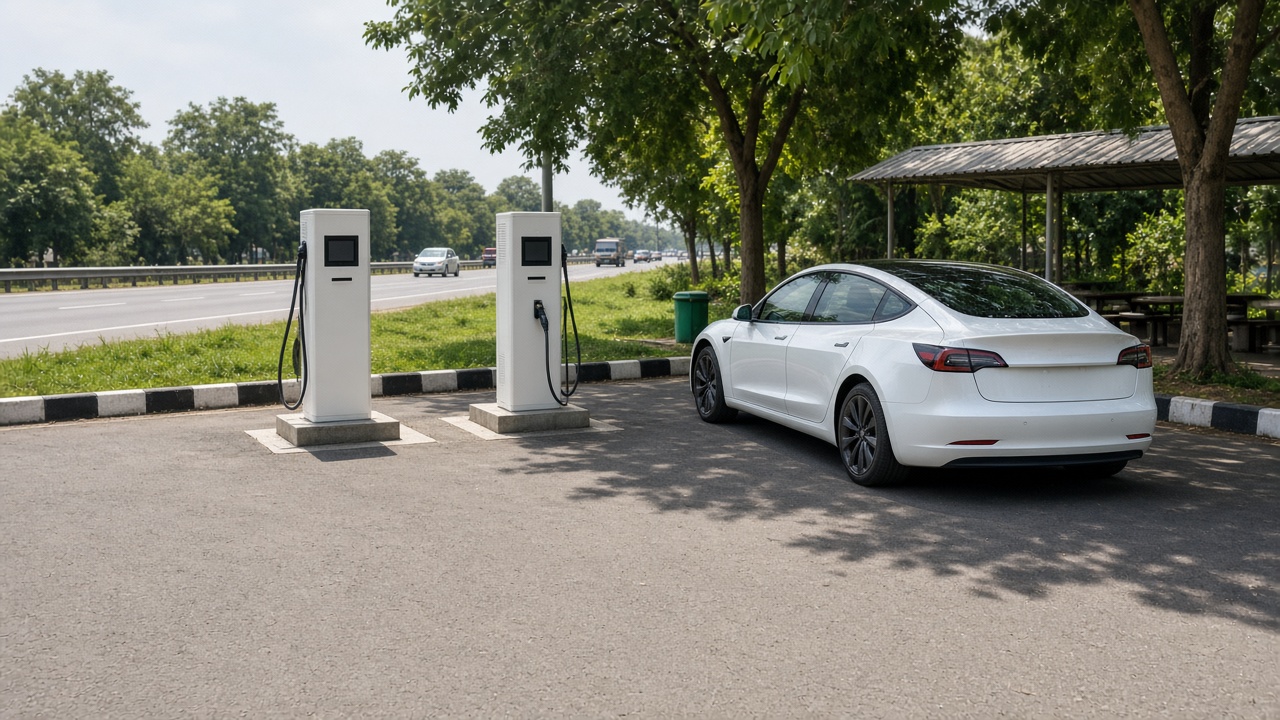
DC charging is for drivers who need to leave, not for cars parked all day.
Published material describes CCS2 outlets, OCPP 1.6J, IP55 and IK10 equipment, and DC output classes including 60 kW and 120 kW. The exact model is confirmed on a datasheet.
How long a session takes depends on the vehicle and the state of charge. We do not promise a full charge in twenty minutes.
Owners of suitable property can ask for a site check before talking about a business model.
Transcribed from the company EV brochure. Confirm every value against the datasheet of the model proposed for the site. The brochures name AC and DC charging. They do not publish a separate AC charger datasheet, so AC ratings are not invented here.
| Input rating | 400 V AC ±10%, 3 phase, 50/60 Hz |
|---|---|
| Power factor | ≥ 0.98 at full load |
| Efficiency | ≥ 94% at full load (peak) |
| Grid type | TN-S, TN-C, TN-C-S, TT, IT |
| Interface | CCS2 + CCS2 |
|---|---|
| Power | DC fast charging. Brochure also refers to 60 kW and 120 kW configurations, with a higher figure that must be confirmed on the datasheet. |
| Voltage | 200–1000 V DC |
| Current | 300 A maximum |
| Display | 10.4 inch touch screen |
|---|---|
| Languages | English; others on request |
| Authentication | RFID, app (optional), card (optional) |
| Network | 4G, Wi-Fi, Ethernet |
|---|---|
| Charger to backend | OCPP 1.6J |
| Charger to vehicle | DIN 70121, ISO 15118 |
| Operating temperature | −30 °C to 50 °C |
|---|---|
| Humidity | 5%–95%, non-condensing |
| Altitude | Up to 2,000 m |
| Ingress / impact | IP55, IK10 |
| Cooling | Forced air |
| Cable | 5 m, or 6 m optional |
| Dimensions | About 800 × 2050 × 750 mm |
| Weight | About 390 kg including modules |
| Mounting | Ground mounted |
| Marks named on the brochure | CE, IEC, ISO as applicable — confirm the certificate for the exact model |
Cost follows roof size, structure, cable runs and the equipment named in the proposal. This site does not publish a price list, because a number without a survey is not a quotation. A site assessment is the point where a figure becomes real.
Eligible residential rooftop systems can receive central support under PM Surya Ghar: Muft Bijli Yojana — ₹30,000 per kW for the first 2 kW and ₹18,000 for the third kW, capped at ₹78,000. Apply through pmsuryaghar.gov.in. Eligibility, DISCOM commissioning and vendor conditions decide the outcome. Commercial connections are outside this residential subsidy.
Surplus generation can be exported and credited under the local DISCOM’s net-metering rules — TGSPDCL or TSSPDCL in Telangana, and the relevant AP DISCOM in Andhra Pradesh. The credit rate and the paperwork are set by that utility, not by a standard national promise. We help prepare the application after the design is agreed.
The physical installation of a typical home system is often a few days once equipment and approvals are in hand. Utility permission can take longer and varies by DISCOM. The proposal will separate site work from waiting on the utility.
Free quote
Get a free quote for rooftop solar, inverters and batteries, or an EV charging station. Share your PIN code and monthly bill, and we reply with a price range and a PM Surya Ghar check, then a free site visit turns it into a proposal.
